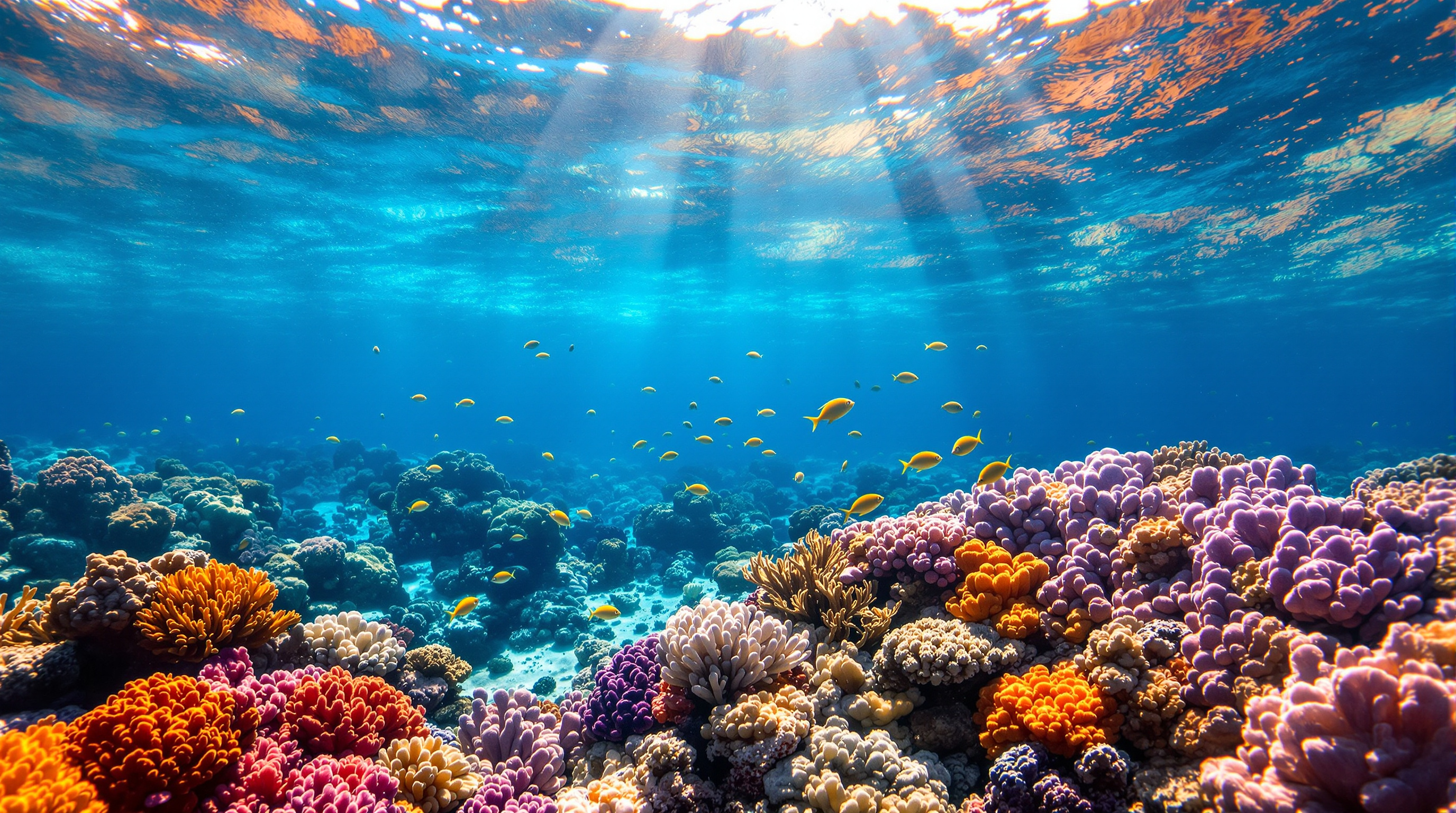
When we talk about reef health, the first question is what a figure actually measures. A global heat-stress total, a regional health rating, and the amount of reef protected from fishing answer different questions. Read together, they offer a more useful picture than any one headline. Keeping their dates and geographic scope attached is especially important when thinking about the Mesoamerican Reef.
The fourth global bleaching event
NOAA, working with the International Coral Reef Initiative, confirmed the fourth global coral bleaching event on April 15, 2024. In its June 2, 2026 Coral Reef Watch status summary, NOAA reports that bleaching-level heat stress affected approximately 84.4% of the world's coral reef area between January 1, 2023 and September 30, 2025. Mass bleaching was documented in at least 83 countries and territories. The headline says the event likely ended in 2025.
The comparison with earlier events helps explain the scale. NOAA gives 68.2% as the share of the world's reef area exposed to bleaching-level heat stress during the third event, from 2014 to 2017. The first and second global events occurred in 1998 and 2010. These are global comparisons: the 84.4% figure describes exposure to bleaching-level heat stress across the world's coral reef area. It should not be read as a percentage of Roatan's reef that bleached, or as a measurement of local coral loss.
How the Mesoamerican Reef is scored
The Healthy Reefs Initiative report cards bring the focus to the region, drawing on two decades of data across four countries. The 2024 card reported that reef health increased for the first time in five years, mainly because herbivorous fish increased. The overall health rating nevertheless remained "Poor".
Both parts of that finding deserve space. The improvement describes a direction of change; the rating describes the condition reported. Increased herbivorous fish should not be presented as proof that every aspect of reef health improved. Equally, the overall rating should not erase the reported improvement. We find it more useful to keep the driver, the direction, and the rating in the same sentence when discussing what the card shows.
Protection and fishing pressure
The 2022 report card described a separate protection concern: less than ten percent of the Mesoamerican Reef's coral reef area was fully protected from fishing. It also reported critically low grouper and snapper biomass in three of the four countries. Those findings concern the regional extent of full fishing protection and the reported amount of those fish.
Keep the report year attached when using these figures. They are 2022 findings, while the improvement described above belongs to the 2024 card. A regional protection percentage does not identify the rules at a particular fishing spot. Nor does the statement about three countries give a count for a particular island. For anglers, the useful lesson is to ask about the scope of a claim before applying it to the water in front of them.
A proposed Particularly Sensitive Sea Area
Healthy Reefs also describes work supporting a technical dossier for the proposed designation of the Mesoamerican Reef Region as a Particularly Sensitive Sea Area, or PSSA, under IMO guidelines. Its reef tipping-points and regional protection material describes an initiative with over 70 partner organizations devoted to safeguarding the reef.
The dossier work involves compiling, analysing, interpreting, and integrating ecological and supporting information to strengthen the scientific justification for the proposal. That wording matters: it describes preparation for a proposed designation. It supplies no basis for announcing a completed designation or a particular set of fishing restrictions.
What it means on the water
The same Healthy Reefs material says bleaching events have become more extensive and more extreme, and that exceeding the thermal tipping point accelerates reef decline and the loss of essential ecosystem services. That warning helps explain the concern behind the monitoring and protection work. It does not turn a global statistic into a local observation.
Read the Date and the Scale
For a practical reading of reef news, keep three details together: what was measured, where it applies, and when it was reported. Then consider the finding alongside the others. Our conservation guide provides the wider fishing context for these reef-health questions.
Read the figures
Global heat stress and regional reef health describe different aspects of reef condition. Keep the measure attached to the number.
Scope and dates
The 2022 protection findings and 2024 health rating belong to different report cards. Neither supplies a reef-by-reef local assessment.
A regional proposal
The PSSA dossier concerns a proposed designation. Read the stated stage of the process before drawing conclusions about fishing rules.